Showing posts with label London. Show all posts

Sunday, June 17, 2012

Sentimental Sunday - Women with Hats - Big Hat & Grapes too!

Why can't I just for once post a picture without all the drama?  This week's "Women with Hats" photo is of English actress Edna Loftus (? -1916), this particular picture postcard taken before 1907.  I had never heard of Edna, but  thought to myself I'll just check her out on Wikipedia, write a short bio and be done with it.  Of course it could not be that simple!  Look at this beautiful Edwardian photo of her with the large hat, she is holding grapes in her hands and even appears to have white grapes on her hat.  She is truly a vision of loveliness.

From what little I have been able to learn about her she was an English musical comedy actress, birthday unknown.  Little is know about her early life; from this postcard which is postmarked 1907 I am going to guess her birth date somewhere between 1875 and 1885.  Her career was somewhat modest, however, her personal life was full of drama. As a young woman she went to London and joined a vaudeville-pantomime known there as the "Rein Deers" and evolved from that into a  London music hall star.  During this time her she announced her engagement to Lord Dunbarton of Manchester.  When this was called off she soon became engaged and then married to Winnie O'Connor, the famous English jockey, also famous on American tracks.  She divorced O'Connor and was said to have gone to New York City to appeared on Broadway after 1906.

Edna Loftus 1906
It was reported that while in New York in a Broadway restaurant she met Harry Rheinstrom, a younger man, and a son of a millionaire Cincinnati distiller and he was reported to have spent several thousand dollars on her in a short period of time.  When they announced their intention to marry, his family who strongly objected had her arrested, and had him admitted to a private sanitarium in Ohio.  Miss Loftus procured a writ of habeas corpus and secured Rheinstrom's release on 4 January 1910.  They crossed state lines and were married in Covington, KY on 7 Jan 1910.  He still had to face a lunacy trial through proceedings filed by his mother and have a guardian appointed.  Edna and Harry left for Los Angeles where they took up residency at a chicken farm in Boyle Heights.  After six months they returned to Cincinnati to effect a reconciliation with his mother and to try to procure his inheritance.

There were more drama to come.  She was arrested and accused of bigamy for not legally divorcing her first husband.  Her husband's parents had him readmitted to the sanitarium for his nerves.  After release from jail she went to work as as a cafe singer to pay for his expenses. His parents wanted him back, but without her.  In Dec 1910, now separated from her husband and penniless she jumped into Spreckels Lake in Golden Gate Park in San Francisco to commit suicide.  She was rescued by an passing motorist.  In 1913 Rheinstrom was sent to the insane asylum at Stockton, released a year later, divorced his wife and returned to the East.

In October 1915 suffering from severe illness she tried to sue her former parents-in-law. Edna, whose career was virtually over at this time was also was facing deportation.  According to the Oakland Tribune, she was managing the Art Hotel at 883 Kearny Street, her fame long gone.  She died penniless 16 June 1916 of tuberculosis in San Francisco and was to be buried in the local potter's field until friends intervened and had her buried in Cypress Lawn Cemetery.

Sources:

1. Wikipedia
2.  New York Times

Monday, May 14, 2012

Mystery Monday - Gypsy Woman's Identity Solved!


Mary F. Scott-Siddons as Rosalind
Last week in my Women with Hats post,  I posted a photograph/CDV taken by Napoleon Sarony of New York of an unidentified woman wearing a gypsy-like costume.  Sarony was famous for photographing the many actors and actresses of the theater.  I was looking at vintage photos on e-Bay and typed in “actress” and as I was scrolling through them came across several photographs of my subject – Mary Frances Scott-Siddons.  She was indeed an actress; in fact she was descended from the  famous theatrical family that produced Sarah Siddons, John Philip Kemble, Charles Kemble and Fanny Kemble.  Sarah Kemble Siddons (1775-1831), called the "Tragic Muse" was her great-grandmother and had a prestigious acting award named for her by the Chicago group, the Sarah Siddons Society.    Each year since 1952 the society awards the coveted Sarah Siddons Award for Distinguished Achievement to a theater actor for an outstanding performance.  Some of these great actors have included Helen Hayes, Bette Davis, Lauren Bacall, Claudette Colbert, and too many more to mention.  The award was actually created after a reference to a fictitious award of the same name in the 1950 movie “All About Eve.”

Mary F. Scott-Siddons
As I delved into research about my subject and her famous family I unearthed almost more information than I could process.  As the story goes, her grandfather George Siddons was sent to India in 1803 at the direction of King George III as a favor to Mrs. Siddons.  According to Edwin A. Lee in “Mary Frances Scott- Siddons -A Remembrance,” King George said, “Send him to India—India—fine place—make a fortune there.”  Mary F. Scott-Siddons was born in Bengal, India in 1844 to George Siddons’ son William Young Siddons and his wife the daughter of Col. Earl. Early in life Mary demonstrated a talent for theatrical recitation.  She also strongly resembled her famous great-grandmother who died thirteen years before her birth.  At the age of sixteen she returned to England to further her education with her mother and sister after her father’s death.    At the age of eighteen as she was preparing to go on the stage she married a young naval officer named Thomas Chanter whose parents objected to his marriage into a theatrical family.  The story passed down in theater lore is that they created a last name using his mother’s name Scott and her name Siddons.

She made her acting debut using this new name in Nottingham, England in the role of Lady Macbeth, however, the role it was reported,  was not suited for her.  On April 8, 1867 at the Haymarket Theatre in London she appeared as Rosalind in “As You Like It.”  The Bell’s Life of London said of her performance, “The lady bears a striking likeness to her great ancestress, though her form and figure may be pronounced neat and graceful rather than majestic.  Her conception of a character, confessedly one of the most beautiful in the catalogue of Shakespeare’s heroines, was marked by great intelligence…..and the applause bestowed of the most enthusiastic nature.”

Mary F. Scott-Siddon,
Photographers Elliott & Fry, London
Mrs. Scott-Siddon’s first American appearance as a reader of Shakespeare and other poets in 1867-68 attracted much attention largely because of her rare beauty; her features were aquiline, her eyes large and lustrous, her figure slender.  She appeared at the Boston Museum and  made her metropolitan debut on the dramatic stage as Rosalind at the New York Theater on November 30, 1868. The picture I posted last week has been reported to be from her role as Rosalind, a role she performed in repeated engagements. The criticism from this performance as reported in the New York Tribune was for the most part complimentary, “She is not a great actress, but she is largely gifted with talents, and more that all, with that spark of vital earnestness which makes talent magnetic.  While in New York she also appeared in “Romeo and Juliet,” “Taming of the Shrew,” and “King Rene’s Daughter.”  Upon her next engagement in New York in October of 1869 she appeared as Viola in “Twelfth Night.”  The Daily Times gave a pleasant review in part saying, “She infused into the part a sprightliness, a fascination, an arch humor and at times, a subtlety and delicacy of appreciation that were truly delightful and proved her to be a genuine daughter of Kemble.”

According to the New York Times (obituary) “her theatrical experiences in this country lasted a number of years and were presumably profitable.  As an actress, however, her style was amateurish and her manner cold……For a number of years the sales of her photographs were very large.  She was a remarkably good subject for the camera.”

Thomas & Mary Scott-Siddons 

According to Edwin A. Lee who personally knew the Scott-Siddons, she worshiped at the shrine of Thespis" and her husband Captain “Scott" was a votary of “Bacchus” which caused them to separate and which also most likely caused his death probably sometime in the late 1870’s.  After a long absence from America Mrs. Scott-Siddons returned to this country in the early 1890’s and resided for a while in New York.  After one failed attempt at acting at Palmer’s Theatre in a version of Augier’s “L’Aventuriere”   she was no longer seen in the public eye.  She died in Paris on 19 Nov, 1896 at the age of fifty-two.


Sources:
1.  New York Times, Obituary, Mrs. Scott-Siddons, Published: November 20, 1896.
2.  Wikipedia
3.  Mary Frances Scott-Siddons - A Remembrance by Edwin A. Lee, The Muse Volume Edited by Charles Elston Nixon, The Philharmonic Co, 1903, Pub. Monthly by Arthur B. McCoid, New York (Google e-book).
4.   www.kemblefamily.com
5.  Folger Shakespeare Library
6.  The Broadway League, 
7.  Meserve-Kundhart Foundation

Thursday, February 9, 2012

Those Places Thursday - London, Tower Bridge Past and Present

Tower Bridge Late 1800's early 1900's
Postcard of the Tower Bridge London, most likely depicting the late 1800's to early 1900's (note the horse and buggies on the approach.


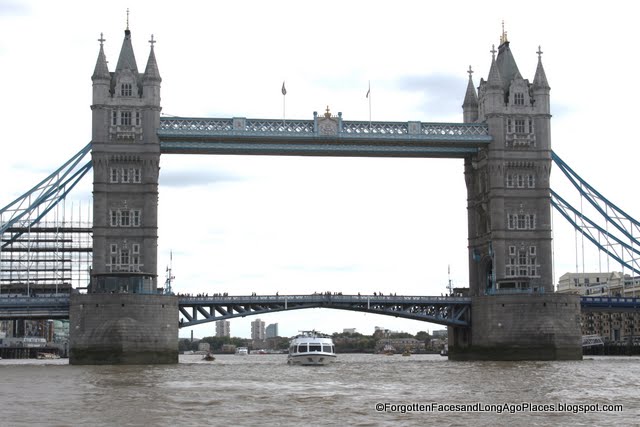
Tower Bridge September 2009
Photo taken by me on my first (and hopefully not last) trip to London in September 2009.
Related Posts Plugin for WordPress, Blogger...